20 Handy Pieces Of Advice For Choosing Termite Extermination Services In Jakarta
Wiki Article
The Battle Of Jakarta's Mud Tubes And Moisture
Jakarta exterminators scrape mud tubes off foundation walls each day and refer to this as termite control. This isn't. It's just routine housekeeping. It is not an enemy but a proof. Termites do not build these channels of earth because they are interested in construction. They construct them because their bodies are filled with water encased in cuticle that is thin enough to desiccate in minutes when humidity drops to below 70. Every mud tube climbing a Jakarta wall is a confession. It marks the exact location where moisture is escaping from the building--condensate from air conditioners and leaky drainpipes rise through porous brick. If anti-termite treatments poison the tube, but don't correct the moisture source they guarantee that the next colony will reappear.
1. Mud Tubes Are Hygrometers, Not Highways
Termites contribute soil to areas of greatest evaporation. A tube that ascends a bathroom's exterior wall indicates vapor escaping through that specific mortar joint. A tube emerging from an edge of a slab indicates that soil is still saturating. When they read tubes to find the moisture maps, not invasion routes, exterminators become experts on building performance. This work is more valuable. This is work with higher value.
2. Twelve Percent is the level of invisibleness
Termites cannot see wood below 12 percent moisture content. Above fifteen percent, it emits detectable volatile compounds. The timber in most Jakarta homes has crossed the threshold of this threshold for many years, and never dried. The anti-termite service that doesn't utilize pin-type humidity meters to gauge every window and door sill as well as embedded beams are making guesses. Clients are paying for certainty.
3. The 300-500mm water belt
The soil directly adjacent to the foundation walls is shielded from rain through roof eaves and is significantly dryer compared to open garden soil. Termites hunt in the region of 300-500 millimeters in the area around the building. It is close enough for them to get to the foundation but also far enough away to be able to absorb rain. In deserts with hydrologic conditions bait stations are set up flush with the wall. Professional installation involves determining the gradient and placing stations in areas where termites eat.
4. Potting Mix is Bait Station Technology.
If a potting mix with a high organic-load is soaked in water and then backfilled all around bait stations, creating a shadow of water, it extends the attraction well beyond the station itself. Jakarta's compacted clay is devoid of the organic content and porosity that termites need. Exterminators that insert stations into native soil, without amending it are installing furniture and not traps. The hole must be more than normal. The soil has to be brought in. The level of moisture must be artificially boosted.
5. Above-Ground stations make use of tube behavior
Above-ground stations are locked directly to active mud tubes, causing termites to traverse toxicant-impregnated matrix throughout their daily journey between nest and feeding site. It's not baiting. It's toll collection. The tube is in good condition, and termites continue to travel, and with each forager they pass the poison is carried back to the nucleus of the colony. Exterminators destroy tubes prior to placing stations, destroying their own delivery system.
6. Water is Attractive and not Repellent
US patent 6023879 issued in the year 2000 describes the method of delivering water around bait stations so that soil moisture is higher than in other regions. This makes termites more attracted to the toxicant. Twenty-five years later, the majority of Jakarta exterminators believe that water is a deterrent to termites. It does not. Resistant chemicals are not suitable to a strategic irrigation. Exterminators who do not water the bait arrays are waiting for termites to arrive through chance rather than planning their entry.
7. Termite Deserts in Lawn Areas
Turfgrass is fertilized with herbicides or pesticides. This reduces the termite's foraging activity. The fertilized, mowed and organically-rich landscaping beds ensure constant pressure on termites. Anti-termite services that distribute monitoring stations across all properties regardless of ground cover are wasting stations on sterile turf and under-sampling high-risk beds. Grids should be focused upon areas where termites reside.
8. Self-Recruiting increases the effectiveness
The introduction of live termites to an empty bait tank soaked in water from a station infested with termites results in a self-recruitment pattern. The termites that are introduced, who are already accustomed with the station environment are immediately fed. This one step can increase the consumption of toxicants by around thirty percent. Jakarta exterminators that eliminate termites from monitoring stations, are wasting their effectiveness.
9. Concrete Coring Is Non-Negotiable
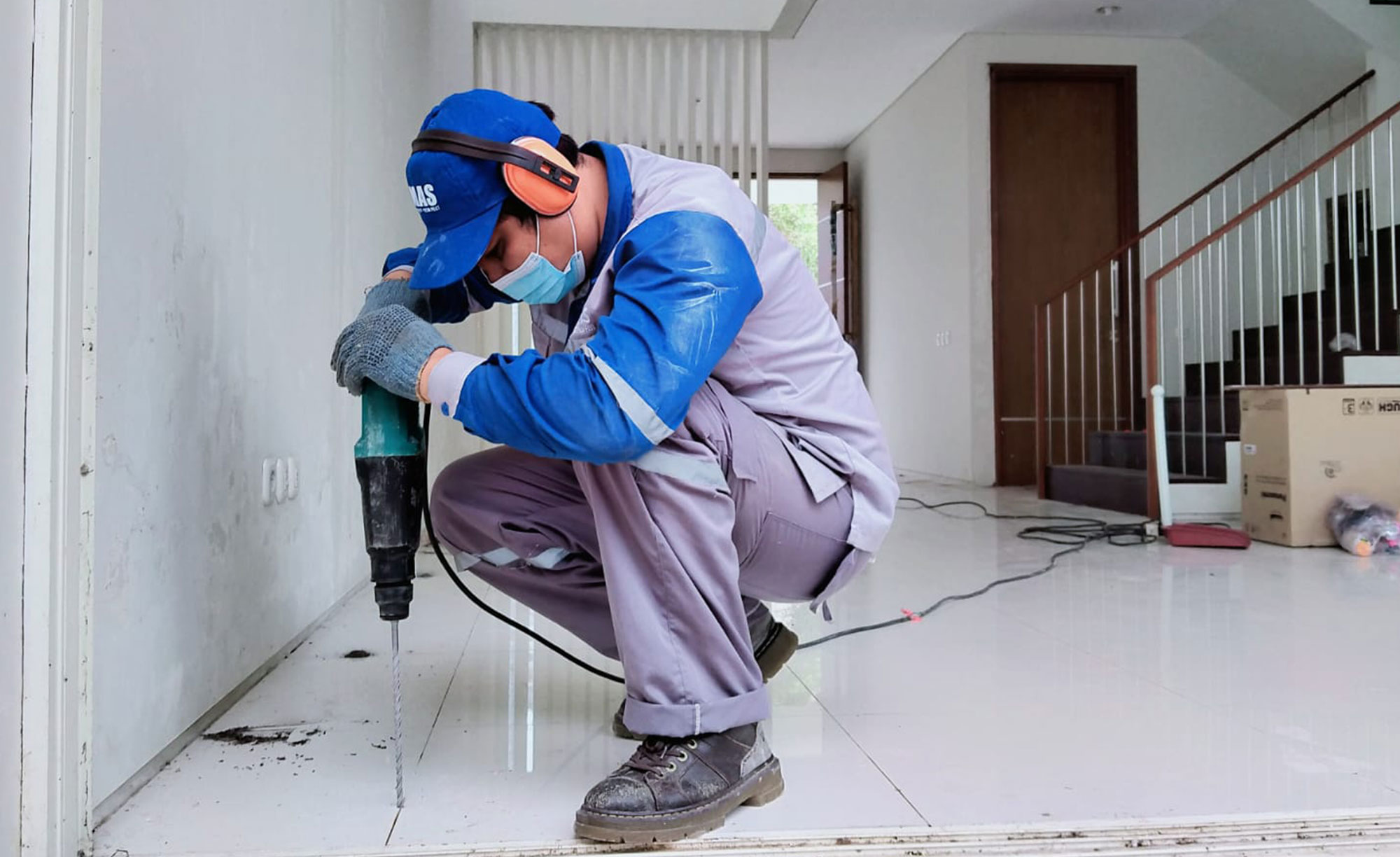
Sealed hardscape--driveways, patios, sidewalks--prevents rainfall infiltration and creates artificial dry zones beneath the building perimeter. Professional procedures include core drilling into the concrete to create bait stations in the soil. After installation the stainless steel caps are inserted flush with the grade. If the homeowners do not want to coring, the anti-termite service will allow 30 to 50% of the area of the building remain untreated. Document the limitation. Do not sign any contracts that ask you to bypass the limitation.
10. Cosmetic maintenance can include scraping tubes
Pest control companies try to convince homeowners that the mud tubes visible on the surface of the soil are the problem and that their removal can solve the problem. It doesn't. It's not true. Homeowners employ exterminators to eliminate colony but not wall cleaning. Jakarta anti-termite service providers that distinguish between cosmetic maintenance and colony removal will dominate this top segment.
Conclusion
Jakarta's fight against moisture mud tubes and termites is not one against termites. It is a battle against the physics. Jakarta's structural deficiencies, drainage failures, soil chemistry imbalances, etc. are all caused by termites. Anti-termite services that position themselves as building performance consultants--arriving with moisture meters, core drills, irrigation tubing, and soil amendments--will win heritage contracts, high-value residential clients, and commercial property portfolios. Prices will determine the success of the services that continue to scrape tubes or selling poisons as if they were in 1995. The moisture gradient is measurable. The irrigation method has been in use for 25 years. It is patent protected. Jakarta exterminators don't have to decide whether or not they'll take these techniques. There is no choice of whether or not to implement or defer these methods. Have a look at the most popular jasa anti rayap for more advice including kitchen set anti rayap, lemari anti rayap, pembasmi rayap, rayap lemari, harga anti rayap, kitchen set anti rayap, cara membasmi rayap kayu, jasa pembasmi rayap, cara basmi rayap, kayu yg tidak dimakan rayap and more.

Options For Fumigation Are Available In Indonesian Villas, Such As Jakarta
Indonesian villa homeowners are taught that tent fumigation is the only option for termites that infest wall cavities and roof spaces or embedded timbers. This is a belief propagated by the fumigation companies and defended by homeowners' fear. The tent is blown down, the neighbor complains, family members leave the home for three whole days, colony within the walls dies. In 18 months, the colony in your backyard will rebuild the tunnels to eat without being affected by gas. Fumigation can sterilize a building but has no effect on the landscape reservoir. The Jakarta anti-termite businesses that support the villa industry offer viable alternatives not as a charity, but rather to gain an edge in competition. Clients with eight-bedroom estates in Pondok Indah or a vacation compound in Puncak don't want to tent. The colony must be eradicated without the stress of evacuation, or the unsettling spectacle.
1. Fumigation Kills Termites in the Termite's Nest; Baiting kills colonies
The tent fumigation delivers deadly gas levels into every void in the envelope of the building. Every termite in the structure is killed. The colony living located under the driveway, garden or neighbor's property does not end up dying. Through trophallaxis, this bait delivers toxicant directly to the nucleus of the colony. The colony will eventually die. The structure becomes reinfestation-resistant because the source population is eliminated. Homeowners who understand the difference don't usually choose to fumigate twice.
2. Heat Treatment Permeates Where Gas is Not able to
The whole-structure heat treatment increases the internal temperature of wood up to fifty degrees Celsius and then maintains it for an hour. This kills all living organisms including eggs. It is not necessary to tent and there aren't any chemical residues left in the wood. This is perfect for Indonesian Villas with exposed beams intricate carvings and historic timber. The equipment is in place. The equipment exists. The homeowner must be aware of the alternatives.
3. Electro-Gun Technology For Localized Infection
The high-frequency microwave emits radiation which excite water molecules in the wood. This causes dangerous heat that does not affect other materials within certain areas of infestation. If a villa owner discovers active termites within one carved wooden door frame roof truss, roof beam or any other wood structures the electro-gun will eliminate the infestation without having to evacuate their home. Jakarta exterminators decided not to use this technology from a commercial source. It is not an experimental method.
4. Wood Injection Systems Preserve Architectural Fabric
Liquid borate solutions injected under pressure in drill holes migrate through the timber via capillary action, making the entire component toxic to termites over the course of years. The holes for drilling are less than nail holes that are already in use. The carving is intact. The door frame is in its original position. Indonesian villa owner often reject this treatment when exterminators offer it after they suggest replacement. Offered before replacement, injections are generally approved.
5. Baiting above the ground for hidden cavern colonies
The standard method of fumigation that is used when Coptotermes Gestroi constructs an aerial nest within the wall cavity or roof void is tent fumigation. Above-ground stations that are connected to the active mud tube arising from the ceiling's baseboards and then secure them deliver toxicant direct to the nest. When construction workers exit the tubes that are baited they are devoured by their own nest. No tent. No evacuation. No evacuation.
6. Nitrogen Freezing for Small-Scale Heritage Components
The termites are quickly frozen by liquid nitrogen circulated in sealed chambers surrounding the wood. Then comes the freeze-thaw cycle and repeated. Cryogenic baiting isn't a chemical intervention. Nitrogen freezing can help keep the patina of antique or museum high-end Javanese carvings and furniture.
7. Physical Barrier Retrofits Prevent Re-infestation
The villa which fumigates each year, without ever installing physical barriers and is renting temporary sterilization. The excavation around the perimeter of stainless steel mesh and polymer sheets prevents termites below ground from entering a structure. When combined with a permanent exclusion system, fumigation alternatives are very persuasive. Make a case for the combination by baiting to kill the colony, then installing the barrier so that it's the last colony ever to inhabit the structure.
8. Carbon Dioxide Purging for Enclosed Spaces
Carbon dioxide pressurized into the attic space that is sealed or crawl areas releases oxygen into a lethal level for termites confined within those voids. This is a situation that requires a limited amount of containment, but not full-building tenting. CO2 is a gas that dissolves very quickly, does not leave any residue, and poses no risk to the inhabitants when re-entry procedures are adhered to. The fumigation of Indonesian villas is unnecessary in cases where termite activity on roofs is low.
9. The Baiting Timelines must be disclosed upstream
Fumigation kills the termites colony in 72 hours. Baiting eliminates colonies within 6 to 8 weeks. Villa owners used to the pace of tenting, reject baiting if the timeframe is made public after mobilization. If the timeline was revealed prior to the contract, it is considered an acceptable price to avoid evacuation. Jakarta antitermite services which conceal baiting period until after the proposal delivery are causing their own closing rate issues.
10. The Reservoir Colony Should Be Targeted
Every villa in Jakarta is within the range of at least one colony parent within a nearby green space or cemetery, or on undeveloped land. Fumigation doesn't affect this colony. The colony is not affected by injections, heat treatments, or baiting except if it is located beyond the boundaries of an object. Landscape baiting grids are an effective fumigation option that target the colony on the outside which could in turn re-infest your house in 18 months. Exterminators who treat the structure, but not the reservoir provide temporary relief and not lasting exclusion.
We also have a conclusion.
Indonesian homeowners of villas don't want to leave. They don't want to have tenting equipment set on their lawns that are well-maintained. They don't want neighbors to inquire about the ailment. They would like the colony to be dead, and to be assured that it won't come back. Fumigation doesn't accomplish the second objective and only achieves the first. Baiting, heat treatments, wood injection with microwave technology, nitrogen freezing, CO2 purging and physical barrier retrofits deliver both goals when used as integrated protocols rather than other alternatives. Jakarta anti-termite solutions that present themselves as alternative fumigation service providers, deploying multiple elimination technologies, training technicians on species-specific protocols selection and logging results from reinfestation prevention will capture the premium villa segment currently held captive by tenting contractors. The equipment is huge. The training investment continues. The market demand is already there. There is a demand. There is a debate as to which exterminators are scheduled to arrive with different procedures that have been recorded and will not default to tents. Take a look at the most popular anti rayap for blog advice including anti rayap untuk kayu, harga anti rayap, pembasmi hama, pest control harga, anti rayap kayu, cara membasmi rayap di lemari, pengendalian hama, jasa rayap, anti rayap, pembasmi rayap and more.